DIGITAL RESERVES

Listed in chronological order
Drawing of Two Figures in Giotto's Ascension of St. John (fresco, 1320) in the Peruzzi Chapel of Santa Croce, Florence. Produced in Florence in ca. 1487-89, before during or shortly after Michelangelo's apprenticeship to Domenico Ghirlandaio. Sta. Croce was the parish church for the Buonarroti family during Michelangelo’s youth.
Drawing of St. Peter in Masaccio's Tribute Money (fresco, 1427) in the Brancacci Chapel, Santa Maria dei Carmine, Florence. Produced in Florence in ca. 1487-89, before during or shortly after Michelangelo's apprenticeship to Domenico Ghirlandaio.
Madonna of the Steps, squashed relief, ca. 1490-92. Produced in Florence while studying in the “ Medici Gardens” under the tutelage of Bertoldo di Giovanni. Emulates works by Donatello. Now in the Casa Buonarroti, Florence.
Battle Relief, high relief, ca. 1492. Produced in Florence while studying in the “ Medici Gardens” under the tutelage of Bertoldo di Giovanni. Emulates ancient sarcophagus reliefs and neo-antique reliefs by Bertoldo di Giovanni. Now in the Casa Buonarroti, Florence.
Unfinished painting of Madonna and Child (Manchester Madonna)), tempera on panel, ca. 1488-94. Probably produced in Florence, during Michelangelo's apprenticeship to Domenico Ghirlandaio or while studying in “ Medici Garden” or later. Now in the National Gallery, London.
Statues for Shrine (Arx) of S. Domenico in San Domenico, Bologna. marble, 1495. Produced in Bologna. Still in San Domenico, Bologna.
The casket of the founder of the Domenican order was carved by Nicola Pisano and his assistants in ca. 1265-67. It was moved in 1411 to a special chapel between the nave and the chapel of the Domenican monks. The marble canopy with statues of saints and angels was added by Niccolò da Bari (who for his work became known as Niccolò dell'Arca) in 1469-73. When Niccolò died in 1494, sixteen of the twenty one statue for the canopy were complete. Michelangelo obtained the commission for three missing statues through the good offices of Gianfrancesco Aldovrandi, in whose home he lived while in Bologna.
Angel bearing Candelabra by Niccolò dell’Arco
Angel bearing Candelabra by Michelangelo
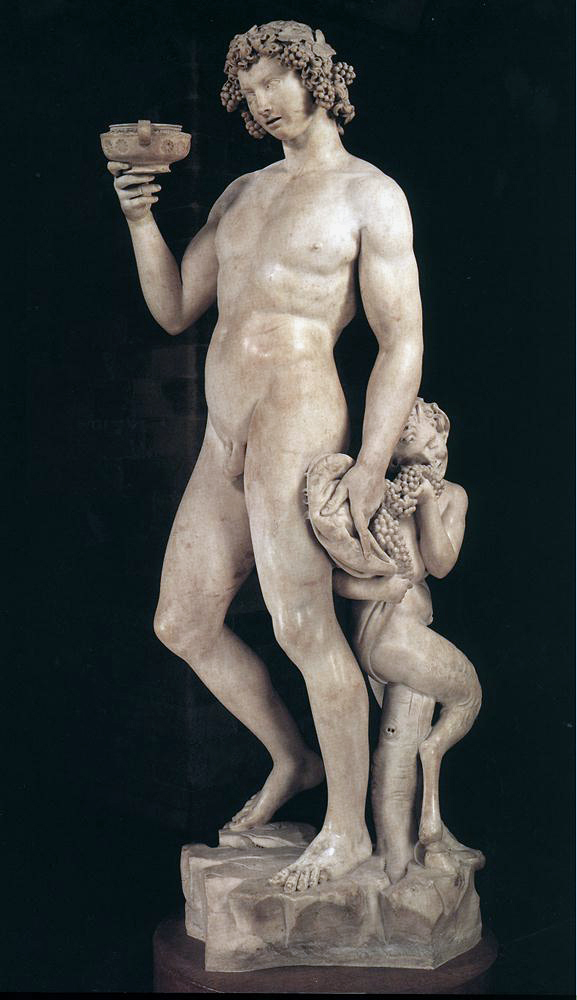
Bacchus, marble statue, 1496-7. Produced in Rome. According to contemporary letters, the work was commissioned in 1496 by Cardinal Raffaello Riario, probably for the courtyard of the Palazzo della Cancelleria. It was completed within a year, but remained in Michelangelo’s possession, probably because Riario refused payment for it. Sometimes thereafter it was purchased by the Florentine banker Jacopo Galli, whom Condivi wrongly credited with having commissioned it. In the 1530s, it was in Galli’s sculpture garden, where it was recorded in a drawing by Maarten van Heemskerck. At this time, as his drawings show, the statue lacked a left hand and genitals. It has been assumed that they were lost to damage, and a hand with a cup was later added in restoration, but it is possible that the work was produced by Michelangelo to look like a damaged classical remain. Now in the Museo Nazionale del Bargello, Florence.
Drawing of 1532-5 by Maarten van Heemskerck, showing the statue in the sculpture garden of Jacopo Galli.
Roman Pietà, marble statue group, 1498-99. Commissioned in 1498 by Cardinal Jean Villiers de Fezenzac (also called Jean Bilhère de Lagraulas), probably for his tomb in the church of St. Petronella then adjoining St. Peter's. Now in St. Peter's basilica, it is the only work signed by Michelangelo.
Unfinished painting of the Entombment of Christ, tempera on panel, ca. 1500-1. Probably the altarpiece commissioned in 1500 for the tomb of Bishop Giovanni Ebu in Sant’Agostino, Rome. Now in the National Gallery, London.
David, marble statue, 1501-4. Produced in Florence and installed in front of the Palazzo Vecchio in the Piazza della Signoria. Commissioned by the Operai del Duomo, the Office of Works of Florence Cathedral. The project for the colossal statue extends back to 1464 when the marble was quarried for and the statue begun by Agostino del Duccio, who was almost certainly working under the direction of the aged Donatello. Donatello died in December 1466 and the contract was cancelled. Ten years later the commission was transferred to Antonio Rossellino but the work went badly and was abandoned. Michelangelo was awarded the commission in 1501, after a call went out seeking artists willing to finish the statue. It was begun on September 13, 1501, and was described as "half finished" on February 28, 1502 and as almost complete on January 25, 1504. A meeting was held on January 25, 1504 to discuss where the statue should be placed. Between May 14 and May 18, 1504, it was transferred to the Piazza della Signoria, and it was installed in front of the Palazzo Vecchio, where it replaced Donatello's Judith, on June 8, 1504. It is now in the Galleria dell' Accademia, Florence.

Drawing with Studies for the marble and bronze David, 1502. Produced in Florence. The drawing shows a study for a bronze statue of David commissioned by the Council of Florence for Pierre de Rohan, Marshall of Giè, and, inverted, a study for the arm of the marble David. The bronze David was cast in 1508, after Pierre de Rohan had fallen from favor, and it was sent as a present to Florimund de Robertet, Secretary of Finance to the French King Louis XII. The bronze statue was lost in the 17th century.
Taddei Tondo, a round marble relief, ca. 1503-5. Produced in Florence. Commissioned by Taddeo Taddei. Now in the Royal Academy, London.
Pitti Tondo, a round marble relief ca. 1503-5. Produced in Florence. Commissioned by Bartolommeo Pitti. Now in the Museo Nazionale del Bargello, Florence.
The Battle of Cascina cartoon is a lost drawing or modello, dating ca. 1504-5, that was to serve as the template for a giant fresco, which was never painted. In 1504, the Signoria or ruling body of the Florentine Republic, headed by Pietro Soderini, commissioned Michelangelo to paint a fresco of the Battle of Cascina in the Grand Council Room of the Palazzo Vecchio (the city hall). The fresco was to serve as a pendant to a fresco by Leonardo da Vinci of the Battle of Anghiari, which was then in progress, but was soon abandoned by Leonardo due to damage caused by moisture from rain. Michelangelo completed and piece together the cartoon, or life-size drawing, in December 1504. It was displayed the following year and became a "school for the world." It was destroyed in the late 1540s. The cartoon is known only through Michelangelo's preparatory studies and through copies. The best copies are a painting and engraving by Aristotile da Sangallo from ca. 1542.
Copy of Michelangelo's Battle of Cascina cartoon, engraving by Aristotile da Sangallo ca. 1542, H. 43-45.
Bruges Madonna, marble statue group, ca. 1503-1506. Commissioned by Alexandre Mouscron, a Flemish cloth merchant, in 1503. Scholars think that the statue may have been conceived, if not actually begun, as one of fifteen statues for the Piccolomini Altar in the Cathedral of Siena, which was commissioned from Michelangelo in 1500 or 1501, shortly before he received the commission for the marble David. He still had not delivered the works when his patron was elected Pope Pius III in 1503. Pius III died a month after his election and the following year Michelangelo delivered four small statues of saints to his heir. In December 1503 (after Pius had died), he accepted the first payment from Mouscron. The work was delivered in late 1506 and is still displayed in the Church of Notre-Dame, Bruges. Condivi wrongly says that the Madonna was made of bronze. Vasari repeats this mistake and also wrongly describes it as a tondo.
St. Matthew, unfinished statue, 1504-8. Produced in Florence. In 1503, the Operai del Duomo commissioned Michelangelo to carve twelve over-life sized statues of the Apostles for the Cathedral of Florence, to be completed one per year, with the first figure due by the end of 1504. Marble was delivered in December 1504, and the St. Matthew perhaps was begun before Michelangelo departed for Rome in March 1505. The contract was cancelled in December 1505, but Michelangelo probably worked on the figure in Florence during the summer of 1506 after returning from Rome, and again March and April 1508 after he returned from Bologna. The unfinished statue shows Michelangelo's working technique. It is now in the Galleria dell"Accademia, Florence.
Doni Tondo, tempera on panel, 1504 or 1506. Produced in Florence. The work was either commissioned by, or painted as a present for, Angelo Doni, Michelangelo's boyhood friend, and his wife Maddalena (born Strozzi) on the occasion of their marriage in 1504, or after Michelangelo returned from Rome in ca. 1506, as a votive for the birth of a child. Michelangelo also designed the frame, carved by Marco and Francesco del Tasso, which bears the entwined symbols of the Doni and Strozzi families. The tondo is now in the Uffizi Gallery, Florence.
Julius Tomb. Projects of 1505-6, 1513, 1516, 1532 and final version of 1542-7. In 1505, when Michelangelo was entrusted by Julius II to design and construct his tomb, Michelangelo must have believed it to be the most significant commission he would ever receive, but it became the tragedy of his life. His initial design called for more than 40 life-size figures, deployed on a 3-story high freestanding tomb. The original site of the tomb is not known for certain, but most agree that it was to go in the choir of Old St. Peter's. Michelangelo spent nine months quarrying marble, but when he returned to Rome in January 1506, he discovered that the Pope had lost interest in the project. He left Rome without taking leave of Julius and later had to make amends with him, meeting the Pope in Bologna. After Julius died, his heirs repeatedly tried to enforce the original terms of the contract. Contracts for a tomb progressively reduced scale were drawn up in 1513, 1516, 1532, and 1542, but Michelangelo seldom had the time, and was never given the resources, to complete the tomb. Finally, (according to Vasari) Pope Paul III declared the Moses a sufficient tribute for any man and enforced on Julius's heirs a much reduced tomb with the Moses as centerpiece. The completed tomb (1545) is in San Pietro in Vincoli, Rome.
1505-6 Project. Renaissance drawing, perhaps by Michelangelo
1505-6 Project. Modern reconstruction drawing
1513 Project, Renaissance drawing, perhaps by Michelangelo
1513 Project modern reconstruction drawing
1516 Project modern reconstruction drawing
1516 Project. Drawing by Michelangelo for effigy of Julius II.
Completed tomb, 1542-7, in engraving by Teresa Del Po, published 1677
Completed Tomb, 1542-47, seen in situ
Completed Tomb, 1542-47, wholeMoses, 1513-16, marble statue on the Julius tomb. Produced in Rome for the 1513 Julius tomb project; installed in S. Pietro in Vincoli, Rome, in 1545.
Leah, 1542-45, marble statue on the Julius tomb. Produced in Rome for the tomb in its final design; installed in S. Pietro in Vincoli, Rome, in 1545.
Rachel, 1542-45, marble statue on the Julius tomb. Produced in Rome for the tomb in its final design,; installed in S. Pietro in Vincoli, Rome, in 1545.
Other statues related to the Julius tomb project:
Louvre Slaves, marble statues, 1513-1516. Produced in Rome for the 1513 Julius tomb project, but never installed. Now in the Musée du Louvre, Paris.
Florentine Slaves, marble statues, 1519-34 (or ca. 1520-23?). Produced in Florence for 1516 Julius tomb project, but never installed. Now in the Galleria dell'Accademia, Florence.
Victory, marble statue group for the Julius tomb, 1519-1534 (ca. 1527-30?). Produced in Florence for 1516 Julius tomb project, but never installed. Now in the Palazzo Vecchio, Florence.
Sistine Chapel Ceiling. fresco, 1508-1512. Produced in Rome at Vatican Palace. Commissioned by Julius II. (N.B. You are expected to be able to recognize the narrative scenes, including the four in the corner spandrels, and the prophets and sibyls by name and to indicate their location by filling in a diagram like the one below. You will be expected to recognize the ancestors and ignudi as figures from the ceiling, and know what parts of the ceiling that these figures adorn, but you need not be able to identify particular ancestors by name or location or ignudi by location.
Modern drawing showing the chapel before the painting of the ceiling
Detail of juncture between ceiling and wall
Study by Michelangelo for decorative scheme (first stage)
Study for by Michelangelo for decorative scheme (second stage)
Modern diagram of first and second plan for decorative scheme
Modern diagram of decorative scheme of architecture, after Sandstrom
Engraving by Cherubino Alberti, 1577, showing bays with Libyan Sibyl and Prophet Daniel
Histories (main scenes on vault):
Ceiling, detail of scenes from center to entrance
Ceiling, detail scenes from altar to center
Separation of Light from Darkness
Separation of Light from Darkness, rotated
Scenes in corner pendentives:
Prophets and Sibyls:
Ancestors of Christ:
Ignudi:
Nude youth flanking Drunkeness of NoahRisen Christ, marble statue, ca. 1518-1521. Produced in Florence. In 1514, three Roman gentlemen (Metello Vari de' Porcari, Bernardo Cenci, and Mario Scapucci) commissioned Michelangelo to carve a nude Christ for an altar in Santa Maria sopra Minerva, Rome. He began the work but abandoned it unfinished when he left Rome for Florence in 1516, because a black vein had appeared in the marble when as he carved it. In Florence, he was occupied with the project for the facade of San Lorenzo and did not start work on a new piece of marble until late 1518 or 1519. The work was delivered to Rome in 1521 by his assistant Pietro Urbano who was entrusted with finishing it and installing it. Urbano’s poor finishing work may be seen in the feet, hands, nostrils and beard. The gold loin cloth disfiguring the statue is a later addition. The work is still in Santa Maria sopra Minerva, but now in a different spot (to the right of the apse behind the altar).
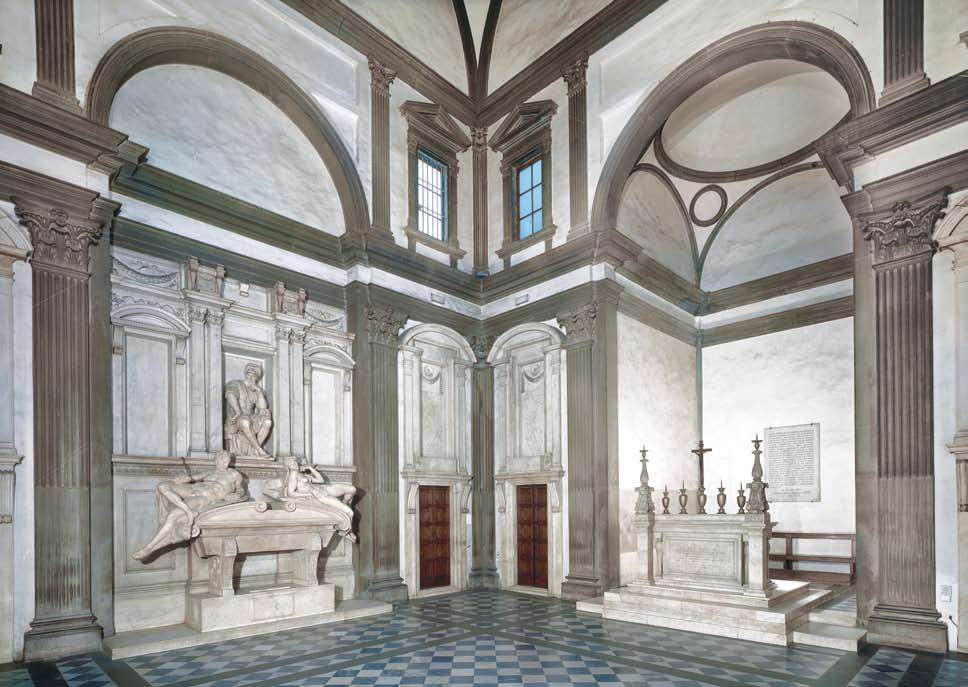
Medici Chapel, church complex of San Lorenzo, Florence, chapel architecture and tomb with ensembles of marble statues, 1519-1534. Produced in Florence. The Medici Chapel and Tombs were commissioned in 1519 by Cardinal Giulio de' Medici (elected Pope Clement VII in 1521). Construction of the chapel began in ca. 1520 and was completed by ca. 1525. Work on six tomb statues continued until Michelangelo left Florence for Rome in 1534. The statues were installed by Vasari after Michelangelo's departure. In the present arrangement, each of the two tombs has a seated duke and two recumbent statues representing “Times of Day”, which are awkwardly mounted on sarcophagi. Originally there were also to have been flanking River Gods and perhaps mourning figures as well. Frescoes were planned for the lunettes above the tombs. The tombs of the capitani face each other across the chapel, and a double tomb for the Magnifici was planned for the wall opposite the altar, where the Medici Madonna and statues of Saints Cosmas and Damian are installed. It is widely agreed that Duke Lorenzo symbolizes the contemplative life and Duke Giuliano, the active life. The architecture of the chapel is based on the Sacristy of San Lorenzo by Brunelleschi (designed 1421).
General view of interior with altar
Interior: view of wall with Tomb of Giuliano de’ Medici
Study by Michelangelo for the double tomb of the Magnifici
Tomb of Giuliano, including statues of Duke Giuliano, Day and Night,
1519-34Giuliano dei Medici, marble statue, in situ
Day, marble statue
Night, marble statue
Tomb of Lorenzo, including statues of Duke Lorenzo, Dawn and Dusk,
1519-34Duke Lorenzo, marble statue
Dawn, marble statue
Dusk, marble statue

Medici Madonna, marble statue group, 1521-34. Produced in Florence. The work remained in Florence along with the Medici Chapel statues when Michelangelo left for Rome in 1534, and was placed in the Medici Chapel by Vasari. Most scholars believe that it was designed for the Magnifici tomb, but all the drawings for this project show a Virgin with legs apart, not with legs crossed as in the Medici Madonna. Possibly it was an independent work that Vasari assumed was part of the Medici Chapel ensemble, when he installed the tombs in the chapel.
Laurentian Library, Monastery complex of San Lorenzo, Florence, architecture of reading room and vestibule, 1521-34. Produced in Florence. The Laurentian Library was commissioned by Cardinal Giulio de' Medici, (elected Pope Clement VII in 1521) in 1519. Construction began in ca. 1524, as work on the Medici Chapel was nearing completion, and continued until Michelangelo left Florence for Rome in 1534. A planned rare bok room (designed ca. 1526) was never built. The famous staircase was designed in ca. 1533. The vestibule was not complete when Michelangelo left Florence for Rome in 1534. The elemnts left behind were eventually installed and the vestibule completed under the supervision of Bartolommeo Ammanati in 1558, after Michelangelo sent him detailed instructions and a small model.
Interior view of vestibule; angle view from entrance
Interior view of vestibule; entrance wall
Interior view of vestibule: wall opposite entrance
Interior view of vestibule; computer simulation, looking down from above
Study for the staircase and the column bases. Drawing by Michelangelo
Presentation drawings of Ganymede and Tityus, 1532. Autograph drawings of Tityus and Ganymede were produced in Florence as presents for a young Roman nobleman Tommaso Cavalieri. Both Tityus and Ganymede are characters from ancient stories about desire and yearning, which in the case of Ganymede in particular is about homoerotic love. Vasari says that the two drawings were intended as models for Cavalieri to copy so that he might learn to draw. But they also express Michelangelo's ardent love for his friend.
Venus and Cupi-d, painted by Jacopo Pontormo from a cartoon (full-size drawing) by Michelangelo. Produced in Florence, 1532-34 on commission from the Florentine merchant-banker Bartolomeo Bettini for the “camera” of his Florentine house.Ganymede, autograph drawing or copy of a lost drawing by Michelangelo, 1532.
Tityus, autograph drawing, 1532.
In 1532, Bettini commissioned Michelangelo to make a full-sized drawing or cartoon of a nude Venus to be painted by Pontormo. This collaboration between Florence’s greatest draughtsman and best colorist was to have been the focal point for the decoration of Bettini’s “camera”, a private chamber that served as a bedroom, study and parlor whose decoration displayed the learning and taste of the patron. The theme of the “camera” was, according to Vasari, “poets who have sung of love in Tuscan prose and verse,” and it included lunette portraits of Dante, Petrarch and Boccaccio (the latter two lost) by Pontormo’s pupil Bronzino. The Venus and Cupid, drawn by Michelangelo and colored by Pontormo, was to have completed the program by giving visual form to the uniquely Florentine understanding of the goddess of love. Unfortunately, it was never installed in the “camera.” In 1534, when Duke Alessandro dei Medici retook Florence, his agents forcibly removed the painting from Pontormo’s studio “in order to do an injury to Bettini” who had supported the anti-Medician Third Republic. Michelangelo subsequently gave the cartoon, now lost, to Bettini who displayed it in his home in Rome. Although it does not appeal to modern tastes, the Venus and Cupid was one of the works most often copied in the 16 th century.
Last Judgment, Sistine Chapel, Vatican Palace, Rome. Fresco on altar wall, 1534-41. Produced in Rome. Commissioned by Clement VII in 1533-34.
When Clement died in 1534, Michelangelo was glad to be out of the commission so that he could complete the Julius tomb. But the new pope, Paul III renewed the commission in 1535, insisting that Michelangelo continue his work on the Papal projects. The scaffolding was erected in 1535, and a letter of 1536 called for MB to follow the cartoons prepared for Clement. This suggests that the subject had already been established as the Last Judgment under Clement. When unveiled in 1541, the fresco was highly praised by artists and by Pope Paul III, but was criticized by reformist churchmen for its artistic license.
Crucifixion for Vittoria Colonna, drawing, ca. 1539. Produced in RomeWhole, from chapel floor, before restoration
Whole, viewed in situ from chapel floor
Christ, Mary and inner circle of Blessed
Detail: Saved ascending to heaven
Detail: Remorse and Deadly Sins
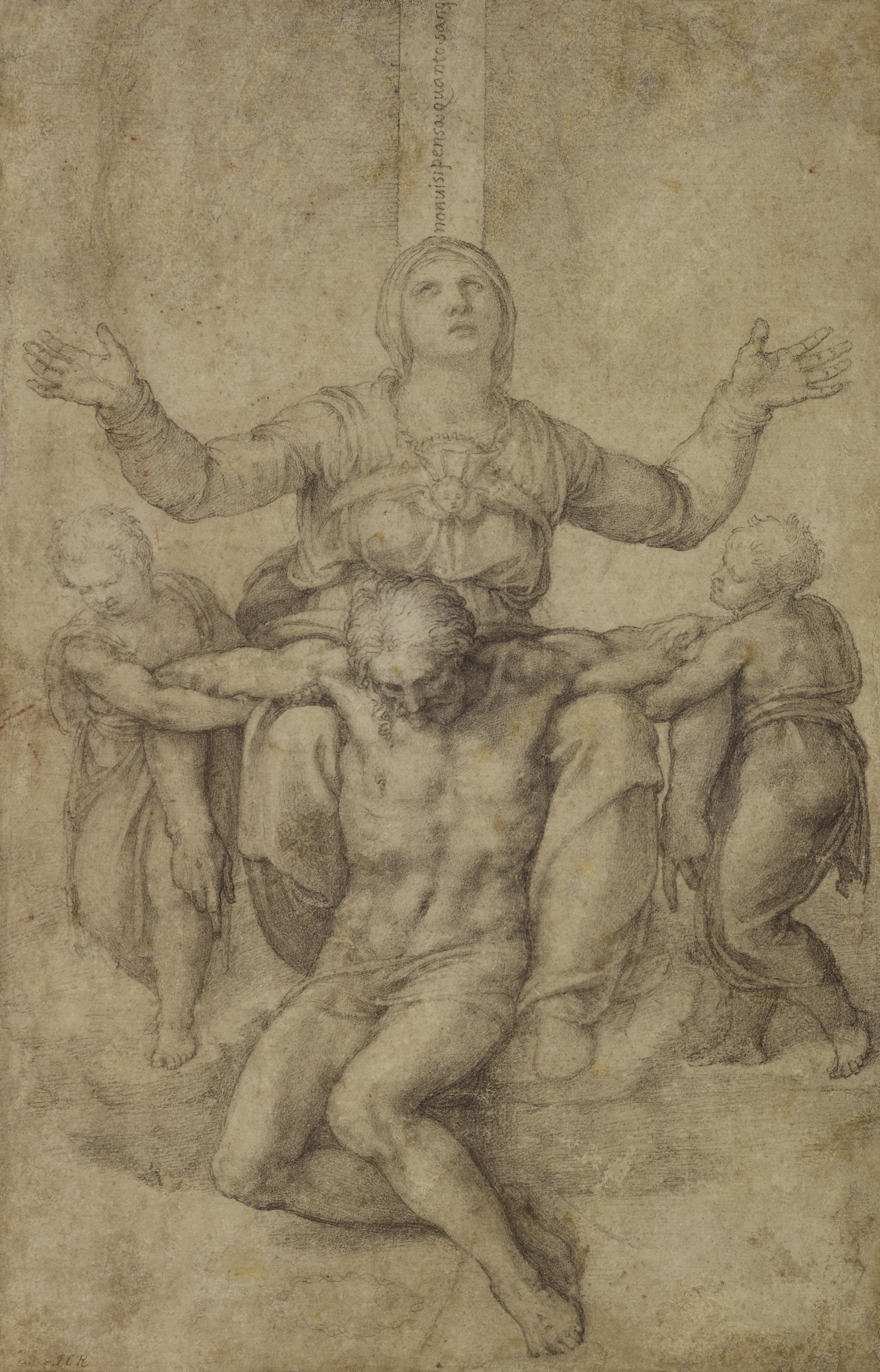
Pieta for Vittoria Colonna, drawing, by 1546. Produced in Rome.
Michelangelo made both drawings as gifts for his friend and spiritual mentor, Vittoria Colonna, Marchioness of Pescara. Michelangelo met Vittoria Colonna in ca. 1536, and visited with her often in Rome in 1538- 1541 and 1544-1547. Through her Michelangelo was introduced to spiritual reformers in circle of Juan de Valdés.
Piazza del Campidoglio, Rome. Architectural ensemble consisting of redesigned facades for two existing buildings, the Senator's Palace and the Conservator's Palace, a new building (the present Capitoline Museum) facing the Conservator's Palace, a pavement, a base for an ancient statue, and a balustrade closing off the fourth side, designed ca. 1537-ca. 1555.
The Capitoline Hill was the ceremonial center of ancient Rome. After a visit to Rome by Charles V in 1536, Pope Paul III decided to renovate the piazza so that it could be used again for civic celebrations. To this end, he moved the bronze equestrian statue of Marcus Aurelius to the Capitoline from the Lateran piazza where it had been since at least the eighth century and perhaps since Antiquity. Although Michelangelo opposed the move, he was commissioned to design the base for the statue, and it was completed in 1538. The first references to a new design for the piazza are later, but the close integration between the piazza and the statue base suggest that the piazza design dates from only shortly after that of the base. Work on the piazza was begun in the early 1540s and continued into the 17th century. In 1979, after an attack on the Piazza, the equestrian statue of Marcus Aurelius was removed for restoration, and later a modern bronze copy was installed in its place. Roman original is now displayed in the Villa Caffarelli section of the Conservator’s Palace.
Pauline Chapel frescoes, Vatican Palace, Rome, two frescoes, 1542-1545 & 1546-1550. Produced in Rome. The Pauline Chapel was constructed by Pope Paul III in ca. 1537 as a private chapel and later served as the site of the papal conclave. In 1541, he ordered Michelangelo to begin work on two frescoes on facing walls, a Conversion of St. Paul and Christ Giving the Keys to St.Peter. Michelangelo began work on the Conversion of St. Paul in 1542 and completed it in 1545. The subject of the St. Peter fresco changed at some point to the Crucifixion of St. Peter, and fresco on that theme was begun in 1546 and completed in 1550. Pope Paul III came to see the work shortly before his death in 1549, but it was not quite finished. The Crucifixion of St. Peter is MB's last painted work.Duperac engraving of complex, 1569
Engraving by H. Cock, showing piazza in ca. 1544-58, with renovation of Senator's Palace underway.
New Palace (Capitoline Museum)
Modern copy of equestrian Monument to Marcus Aurelius, base by Michelangelo, ca. 1537
Conversion of St. Paul, 1542-1545, fresco, Pauline Chapel, Vatican Palace, Rome.
Crucifixion of St. Peter, 1546-1550, fresco, Pauline Chapel, Vatican Palace, Rome.
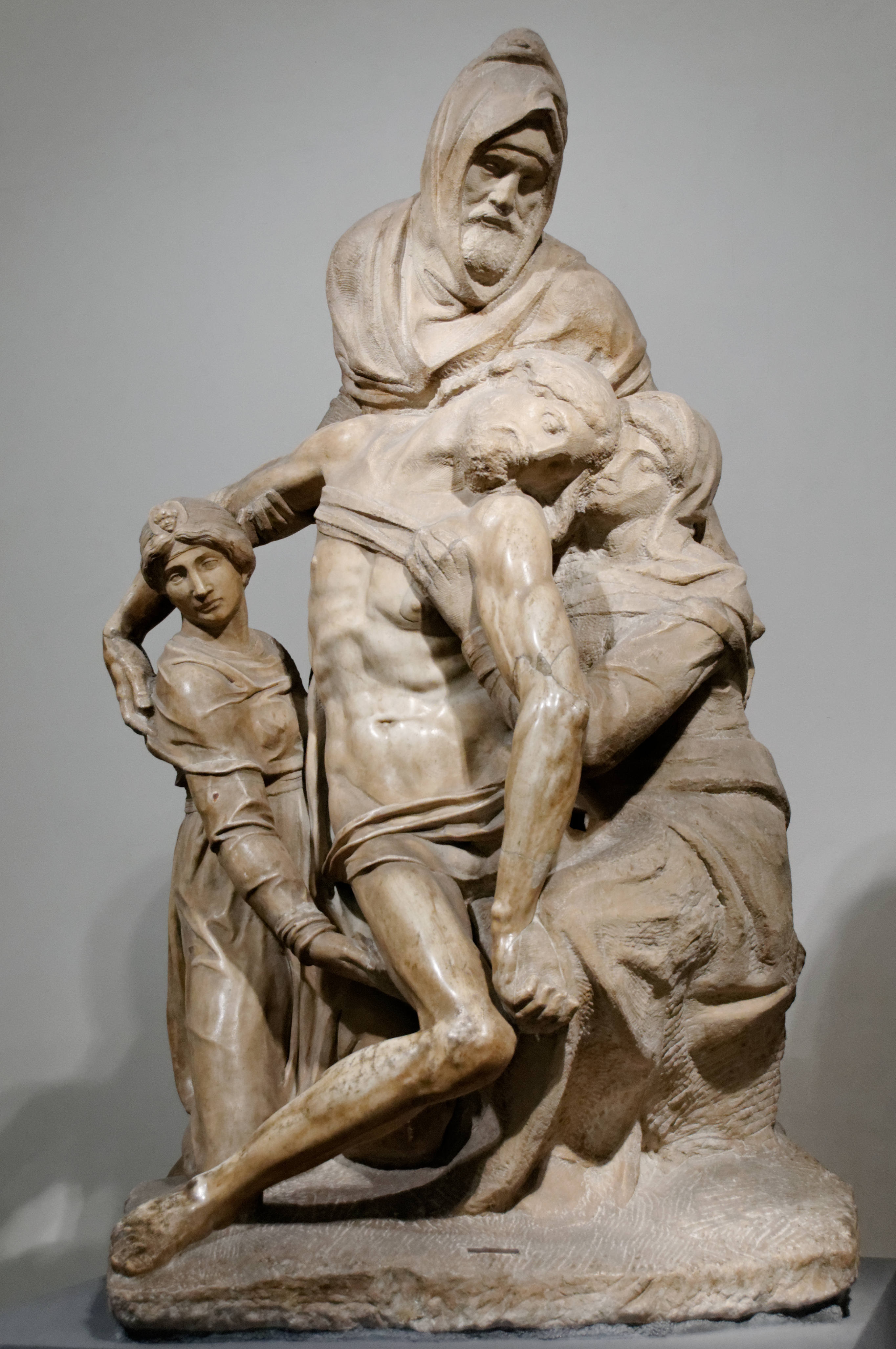
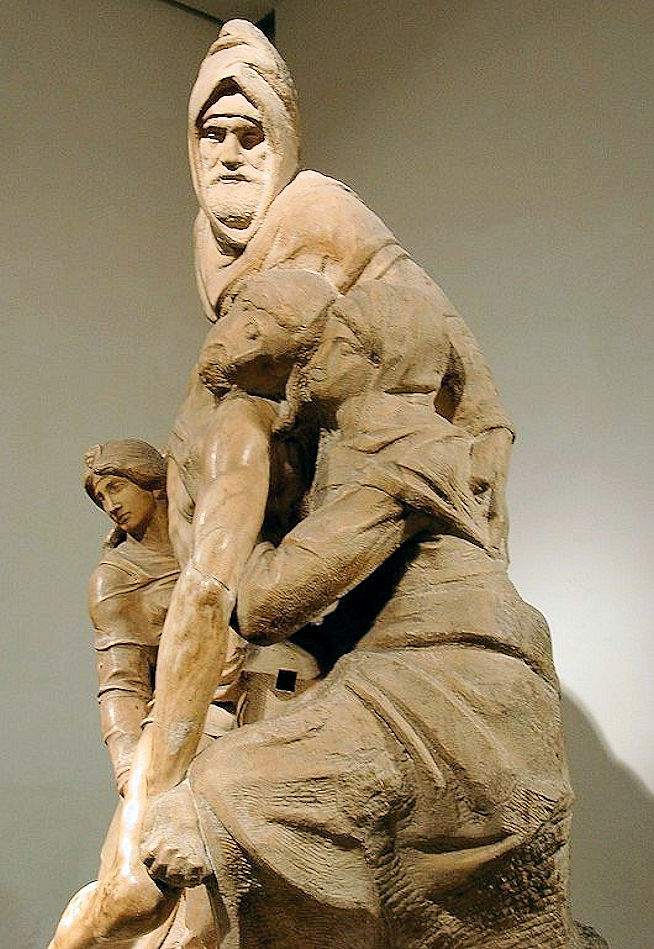
Florentine Pietà, marble statue group, ca. 1547-55. Produced on Michelangelo’s own initiative, while he was working on the Pauline Chapel in Rome. It is first mentioned as a work in progress by Vasari in the first edition of his Lives (completed in 1547, published 1550), who called it a “Deposition” because it includes Mary Magdalen and a standing bearded figure, identified by scholars as either Joseph of Arimathea or Nicodemus. It was still unfinished a few years later when Condivi (written in 1552, published in 1553) reported that Michelangelo intended that the Pietà decorate his own tomb. That Michelangelo intended this four figure group, the most complex single sculpture of his career, for his own tomb is confirmed by the face of the bearded figure, which is a self-portrait of the elderly master. However, the work was abandoned before it was completed. In the second edition of the Lives (1568), Vasari gave the following explanation (which has been subject to much psychological speculation by modern interpreters): pestered by his servant Urbino to complete the work, Michelangelo hastily removed a piece of the Virgin’s elbow and so grew dissatisfied with the sculpture. Then, when a flaw appeared in the marble, he attacked it in a fit of rage and was only prevented from destroying it completely by the intervention of his servant Antonio dei Francesi, to whom Michelangelo gave the piece of the statue. Francesco sold it to Michelangelo’s admirer Francesco Bandini, who with the master’s permission commissioned his pupil Tiberio Calcagni reassemble and complete the sculpture in accordance with Michelangelo’s design. Calcagni reworked the Magdalen with the result that the figure is undersized, patched together the two arms of Jesus and made a square socket (called a “Roman joint” by sculptors) in order to attach a new left leg, which fortunately was never added. The left knee from the original leg was listed in an inventory of the estate of Michelangelo’s pupil, the painter Daniele da Volterra in 1566, but it has since disappeared. The Pietà is now in the Cathedral of Florence.
St. Peter's, Vatican City, Rome. Revised plan, interior and exterior elevations, and dome designed by Michelangelo, 1546-1564. Produced in Rome. Commissioned by Pope Paul III and successors.
Michelangelo was appointed the Supervisor of the Office of Works for St. Peter's in 1546, after the death of his friend Antonio da San Gallo. He took the position, but refused to accept a salary. The rebuilding of St. Peter's, church of the Papal See, was ordered by Pope Julius II in 1506, who entrusted the task to Michelangelo rival the architect Donato Bramante. Bramante began to tear down the Old Basilica, built by the Emperor Constantine in ca. 325 and the most venerable church in Christendom, and to erect four great piers which would support a dome the size of the Pantheon's. His initial design, commemorated in a foundation medallion by Caradosso, called for a central planned " Temple of St. Peter." Since it was based on pagan, rather than Christian, precedents, the central plan was criticized by some church and alternative longitudinal plans for a more traditional basilica were proposed both by Bramante and by the architects who took over the Office of Works after his death. Michelangelo's immediate predecessor, Antonio da San Gallo the Younger, had began work on a comprise plan in which a vast centralized space would be preceded by a single bay. When Michelangelo took over the post of Supervisor of the Office of Works, he declared Bramante's original plan to be the best and devised a revised version of it in which the piers where even more massive and the secondary chapels better integrated with the space under the dome. Michelangelo clarified and revised the designs as construction continued and the building was not completed until 1595, thirty one years after his death. Between 1558 an 1561, he produced four different designs for the dome and drum, including a wooden model in which the dome is hemi-spherical. These served in part as the source for the engravings of Michelangelo's designs published by Duperac in 1569, five years after Michelangelo's death. The profile of the dome as completed in 1595 under the supervision of Giacomo della Porta (who also supervised the completion of the Campidoglio) is elongated like that of dome of the Cathedral of Florence, designed by Brunelleschi in ca 1419.
Duperac's 1569 engraving of Michelangelo's plan
Plans for St. Peter's by Bramante (left) and Michelangelo (right), modern drawings.
Duperac's 1569 engraving of the cross-section elevation of Michelangelo's plan
Duperac’s 1569 engraving of exterior elevation of south side
Rondanini Pieta, marble statue group, ca. 1555-1564. Produced in Rome. Undertaken by Michelangelo on his own initiative. The statue group takes up the theme of the Florentine Pieta, the close physical relation of Madonna and Christ. It went through at least one earlier phase, as evidenced by the fragmentary detached arm of Christ. Michelangelo was still at work on it six days before his death. It is now in the Castello Sforzesco, Milan
Updated: January 24, 2020